my cart0

 Live Zoom Classes
Sort By:
Past-Year O-Level / G3 English Situational Writing Questions (With Formats & Answering Tips)

If your child is preparing for O-Level situational writing, this page gives you both halves of what they need: the actual questions that have come up since 2013, and the techniques for answering them.
Situational writing is Section B of English Paper 1. It asks students to write a practical text, such as an email, letter, speech or proposal, that suits a given purpose, audience and context. It is worth 30 marks, and it is one of the most improvable sections in the entire paper, because format accuracy is fully within a student’s control in a way that creative flair is not.
Below you will find the past-year questions summarised year by year, what the patterns across those years tell us, the format requirements for each text type, and a step-by-step answering approach.
What Is O-Level Situational Writing?
Situational writing sits in Section B of Paper 1 and is worth 30 marks. Students write a response of 250 to 350 words based on a given situation, usually accompanied by a visual text such as a webpage, poster or advertisement.
Together with the editing section and continuous writing, it makes up the 70 marks of Paper 1. Situational writing alone accounts for a meaningful slice of the final English grade, which is why students who tighten up their format and register often see the fastest improvement of their whole English preparation.
The task always specifies three things: who your child is writing to, why they are writing, and what tone to use. Every mark in the paper flows from reading those three correctly.
Past-Year O-Level / G3 Situational Writing Questions (2013 to 2025)
Here is every situational writing task from the last thirteen years, summarised by text type, audience, scenario and the tone the question asked for.
| Year | Text Type | Written To | The Situation | Tone Asked For |
|---|---|---|---|---|
| 2025 | Formal letter | A hiring manager | Applying for one of several holiday jobs the student’s parents had approved | Polite, persuasive |
| 2024 | Speech | A school assembly | As Student Council President, rallying students to help organise the school’s 50th anniversary | Persuasive, enthusiastic |
| 2023 | The school Principal | Choosing which neighbourhood community project should receive money the school had raised | Formal, enthusiastic | |
| 2022 | Letter | The school Principal | Applying for a place on one of three overseas learning journeys | Positive, enthusiastic |
| 2021 | Head of the CCE programme | Choosing one of three community projects to volunteer with | Polite, enthusiastic | |
| 2020 | An aunt and uncle | Advising which overseas trip would suit relatives celebrating a wedding anniversary | Warm, appreciative | |
| 2019 | Letter | An ECG Counsellor | Applying for one of three work experience placements | Polite, persuasive |
| 2018 | The school Principal | Giving views on which of three shortlisted new school facilities should be built | Polite, persuasive | |
| 2017 | An older brother working abroad | Choosing a fitness-related gift and explaining how it would be used | Warm, enthusiastic | |
| 2016 | Speech | A CCA group | Proposing Sentosa as the group’s end-of-year day trip | Persuasive, enthusiastic |
| 2015 | Article | Readers of a travel website | Entering a writing competition by explaining a holiday choice | Lively, engaging |
| 2014 | Letter | A charity’s Projects Organiser | Volunteering for a relief project in a flood-damaged Malaysian village | Polite, friendly |
| 2013 | Letter | An uncle overseas | Choosing one of three educational gifts and explaining its usefulness | Warm, friendly |
Full question papers are available from official SEAB past-year paper compilations. The summaries above are provided so your child can see the shape of the task at a glance.
What These Past Questions Tell Us
Thirteen years of questions in one table makes the patterns hard to miss. Four things stand out.
Email and letter dominate. Nine of the thirteen years called for one or the other. Speech appeared twice, article once. A student who is fluent in email and letter format has covered the majority of what has historically been tested, though the less frequent formats still need to be exam-ready.
Almost every question is a “choose one and justify” task. Three overseas trips. Three community projects. Three shortlisted facilities. The examiner rarely asks for an open opinion. They ask the student to select from options and defend the choice with reasons, benefits and personal relevance. Once your child recognises this structure, planning becomes much faster.
The scenarios stay close to home. School events, family, CCAs, community projects, holiday jobs. No specialist knowledge is ever required. What is required is the ability to write about ordinary situations with precision and the right register.
The tone is always stated, and it is where marks quietly disappear. Every single question specifies the tone: polite and persuasive, warm and appreciative, lively and engaging. Students who skim past that line write a technically competent response in entirely the wrong voice, and lose register marks they never realised were on the table.
Reading question patterns is something we do year after year at Learning Journey. In the 2025 O-Level English paper, our trend analysis correctly spotted three of the six essay topics. Our students had already worked through the material before they opened the paper. That comes from nine consecutive years of studying how examiners set these questions, and it shapes what we teach in every secondary class and workshop.
Situational Writing Formats: Email, Letter, Speech, Report, Proposal & Feature Article.
Examiners never reveal the text type in advance, so your child needs all of them ready. The underlying spine is consistent: greeting, purpose, audience, body organised by the given points, then a closing.
Email Format
- A subject line that states the purpose clearly
- A greeting matched to the audience, formal or informal as the question specifies
- An opening line explaining why you are writing
- Body paragraphs organised by the points in the stimulus, one point per paragraph
- A polite closing line and an appropriate sign-off
Letter Format
- Sender and recipient details, where the question calls for a formal letter
- A formal salutation matching the named recipient
- A clear subject or reference line
- Structured body paragraphs, one idea each
- A formal closing suited to the stated relationship
Speech Format
- Direct address to the named audience, for example “Good morning, teachers and students”
- A clear statement of purpose in the opening lines
- Points delivered in an order that builds towards the aim of the speech
- A closing that reinforces the main message and thanks the audience
Report and Proposal Format
- An objective, factual tone throughout, with opinion kept out unless invited
- Clear sections or headings where the task allows them
- Findings or recommendations presented in a logical sequence
- A closing recommendation that follows from what came before
Feature Article Format
- An engaging opening that draws the reader in rather than stating the obvious
- A tone matched to the publication and readership named in the question
- Content organised around the points given, with each developed rather than listed
- A closing that leaves the reader with a clear takeaway
Task fulfilment carries a substantial share of the available marks. Working out the audience and purpose before writing a single word is what separates a strong script from an average one.
How to Answer O-Level Situational Writing Questions: Step-by-Step
- Read the stimulus twice. Identify purpose, audience and context before anything else.
- Highlight every point you are asked to address. Miss one and task fulfilment marks are capped, no matter how good the language is.
- Circle the tone words. They are always in the question. Write them at the top of your planning space.
- Choose the tone to match. Formal or informal, decided by who is being written to, not by what feels comfortable.
- Plan the format first. Plan the greeting, the body structure and the closing before drafting content.
- Write within the word count. Aim for 250 to 350 words. Well under, and the points stay underdeveloped.
- Keep tone consistent. A formal email cannot drift into casual phrasing halfway through.
- Proofread for tense and pronoun consistency, especially when moving between fact and opinion.
- Ensure all required tasks have been addressed in your response.
This sequence works for every text type, which is exactly why it is worth drilling until it becomes automatic.
Common Mistakes in O-Level Situational Writing
- Ignoring one of the stimulus points, which caps task fulfilment marks regardless of language quality
- Mixing formal and informal tone inside the same response
- Skipping a greeting or closing the format requires
- Writing well under 250 words and leaving the points thin
- Lifting stimulus wording directly instead of paraphrasing it
- Writing in the wrong tone because the tone instruction was skimmed over
Learning Journey’s Situational Writing Workshop
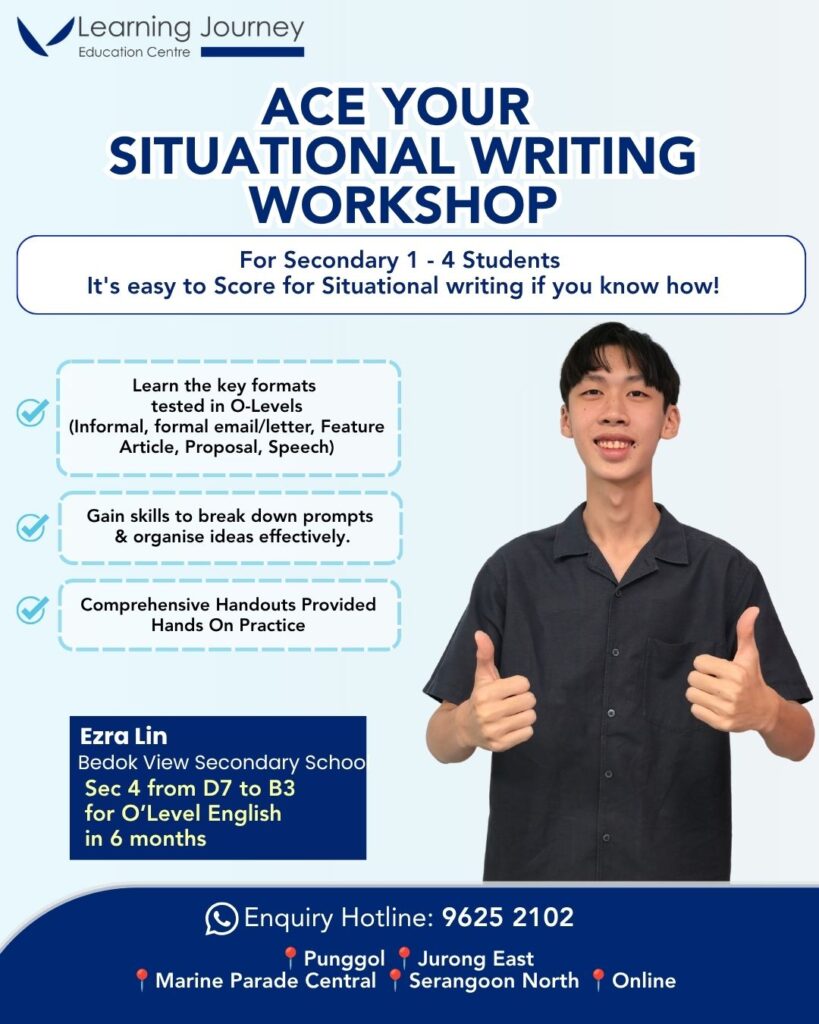
Knowing the formats and actually producing them under time pressure are different things. Our Ace Your Situational Writing Workshop, for Sec 1 to Sec 4 students, is built to close that gap.
Many secondary students struggle to interpret prompts, structure their ideas and express their points persuasively. That is a technique problem, not a talent problem, and techniques can be taught. Students leave able to handle every situational writing format with precision, supported by detailed handouts to reinforce the learning at home.
✍🏽 What we’ll cover:
- 💡 Proposal writing
- 📰 Feature article
- 🎤 Speech
- 📩 Informal and formal letter
- 🖋️ Hands-on practice with individual feedback
- 📚 Comprehensive handouts included
💪 Why this workshop matters:
Your child writes, gets it marked, and finds out precisely where the marks went. Not general encouragement, but specific feedback on register, task fulfilment and format accuracy, which are the criteria markers actually apply. With LJEC’s proven teaching techniques and a supportive environment, students walk away confident in every format.
Proprietary Super Writers™ Framework. We teach essay writing using our own structured methodology, not generic essay templates. Your child learns the reasoning behind effective writing, not just formulas to memorise.
Classes are kept small, with a maximum of 8 students, so every script gets attention and every student gets speaking and questioning time. Our curriculum is current-affairs-driven, which means the examples and scenarios your child works with reflect the real-world contexts these questions are built from.
📅 Workshop details:
- $280 for 2-day × 2-hour workshop
- Suitable for: Sec 1 to Sec 4 students
- Venue: Serangoon centre or online
- Dates: Enquire for upcoming sessions
👉View dates and register for the Ace Your Situational Writing Workshop
For ongoing support, see ourO-Level English Tuition classes or browse ourGCE O-Level essay questions archive.
Prefer to Learn at Your Own Pace? O-Level Situational Writing Video Course
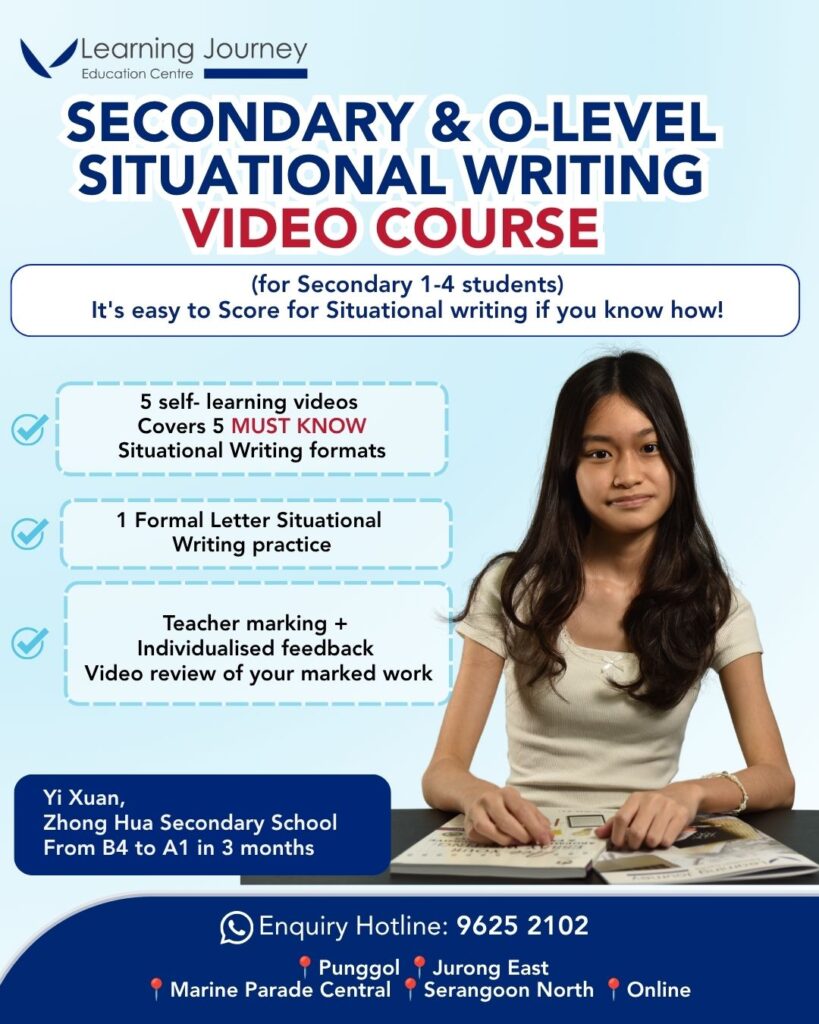
Not every family can make a workshop date, and some students simply revise better on their own schedule. Our O-Level Situational Writing Self-Learning Video Course covers the five must-know formats, with techniques your child can return to whenever they need them.
Situational writing is an easy place to lose marks when a student is unsure of the required format, tone and content. This course removes that uncertainty.
🎥 5 self-learning videos:
✔️ Covers the 5 must-know O-Level situational writing formats
✔️ Key requirements, format and techniques for each type
✔️ What to include, and what to avoid
✔️ 24/7 access for revision
✔️ Learn at your own pace and revise before exams
💻 video course + 1 marking submission | $280
Your package includes:
✔️ 5 self-learning video lessons covering all 5 must-know formats
✔️ 1 Formal Letter situational writing practice
✔️ Teacher marking
✔️ Individualised feedback on your child’s response
✔️ Video review of the marked work
✍🏼 Need more practice?
Additional situational writing practice can be added at $80 per marking, available for other formats including proposal, feature article and speech. Each additional marking includes individualised feedback, a video review of your child’s response, and specific guidance on how to improve.
Learn, practise, get feedback, improve. That loop is what builds real confidence across different formats, and the video review means your child hears the reasoning behind every correction rather than just seeing a mark.
👉Find out more about the O-Level Situational Writing Video Course
For ongoing support, see ourO-Level English Tuition classes or browse ourGCE O-Level essay questions archive.
Frequently Asked Questions
What is tested in O-Level situational writing?
It tests whether a student can write a practical text, such as an email, letter, speech or proposal, that matches the purpose, audience and context in the stimulus, while covering every required point in the correct register.
How many marks is situational writing worth?
Situational writing is worth 30 marks within Paper 1’s 70 marks.
What is the word count for O-Level situational writing?
Between 250 and 350 words.
Which text types appear in O-Level situational writing?
Past papers have tested formal and informal emails, letters, speeches, articles and proposals. Email and letter have appeared most often, but the text type is never announced in advance, so students need all formats ready.
What if we can’t attend the workshop dates?
Our O-Level Situational Writing Video Course covers the same five must-know formats and includes teacher marking with a video review of your child’s work. Students learn at their own pace and can revisit the lessons before exams.
Is Secondary 1 situational writing the same as O-Level situational writing?
The core skill is identical, but Secondary 1 situational writing tasks are usually based on informal & formal emails/letters with simple tone requirements. O-Level questions use layered stimulus material and test students on more challenging tones. Students who build good format habits from Secondary 1 are learning the basics correctly and these best practices will be useful three years later.
How can my child improve at situational writing quickly?
Situational writing rewards format discipline more than natural writing talent, which makes it one of the fastest sections to improve. Regular practice under timed conditions, with someone marking against the actual criteria, produces change within weeks.
Ready to Help Your Child Master Situational Writing?
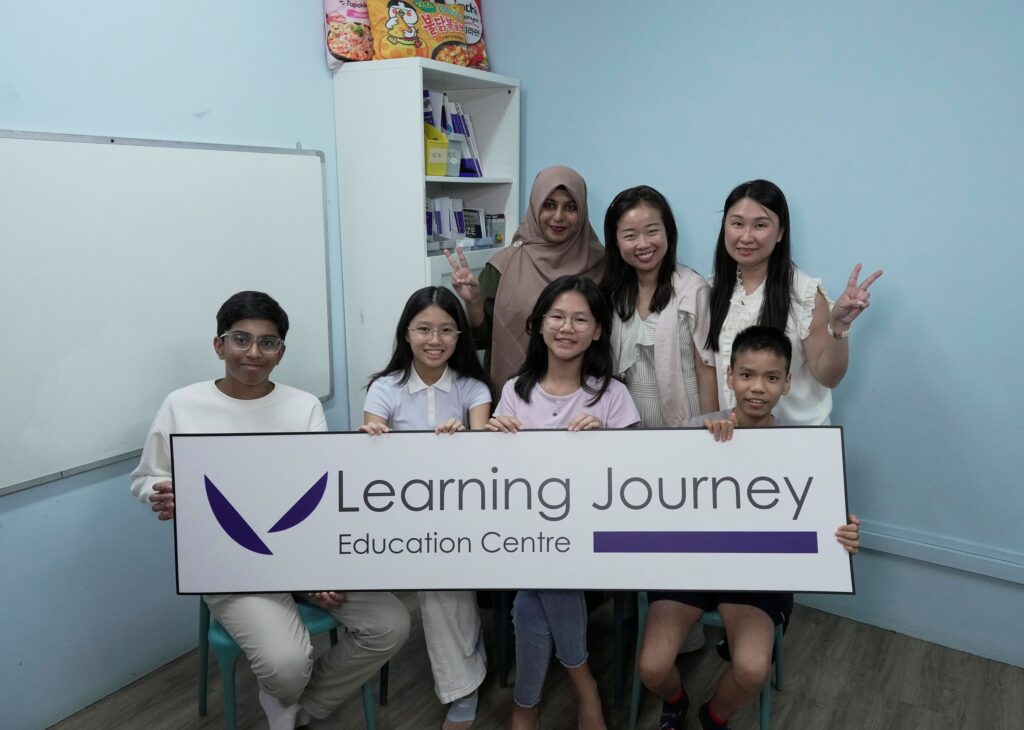
Situational writing is one of the few parts of the O-Level English paper where the marking criteria are entirely learnable. Format, register, task fulfilment. Your child can be trained in all three.
Learning Journey’s English curriculum is led by Principal Grace, author of 9 best-selling English assessment books with more than 100,000 copies sold in POPULAR Bookstores, with 9 years of analysing PSLE and O-Level English trends. In the 2025 O-Level English paper, our trend analysis anticipated three of the six oral topics. Learning Journey has been featured on The Straits Times, Lianhe Zaobao, Talking Point and Nas Daily.
Give your child the format confidence and marked practice they need before O-Levels.
👉Join the Ace Your Situational Writing Workshop
Add in self learning video course
- Website:https://www.learningjourney.edu.sg/
- Phone: +65 9625 2102
Quick Contact
- WhatsApp: +65 9625 2102
- Primary Email: admin@learningjourney.edu.sg
Operating Hours:
- Monday-Thursday: 1-9PM
- Friday: 12-8PM
- Saturday-Sunday: 9-5 PM