my cart0

 Live Zoom Classes
Sort By:
Principal Grace Featured in an interview with CNA938 — 18 September 2026
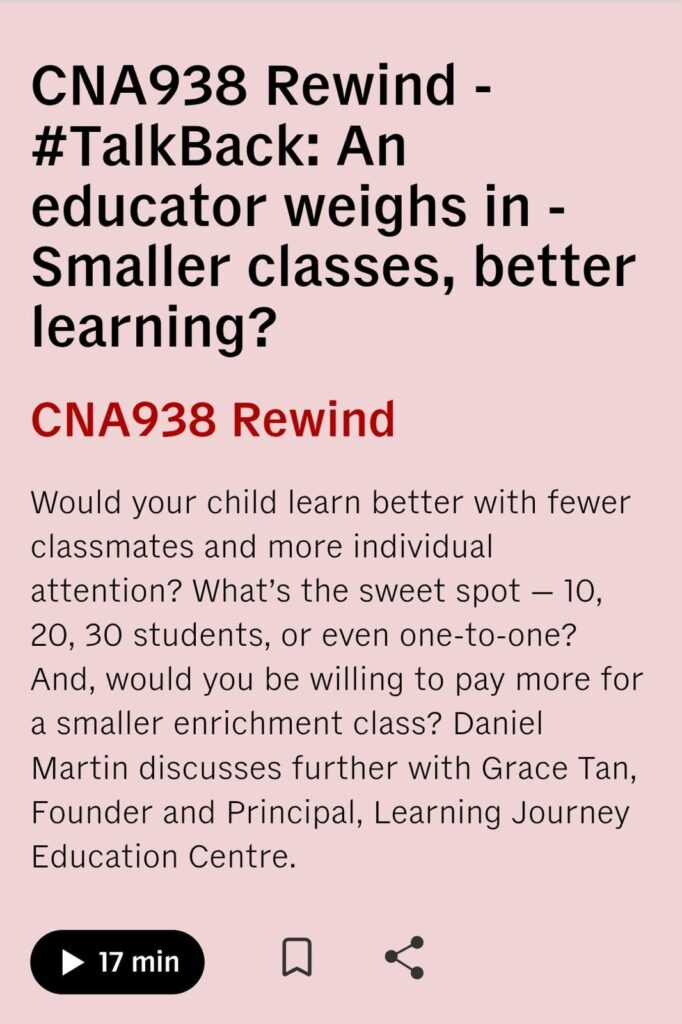
The Sweet Spot: Do Smaller Classes Lead to Better Learning?
Listen to the interview, click here.
Would children learn better with fewer classmates and more individual attention? What is the ideal class size 10, 20, 30 students, or even one-to-one? And would parents be willing to pay more for smaller enrichment classes?
Grace Tan, Founder and Principal of Learning Journey Education Centre, shared her perspective with Daniel Martin on CNA 938, drawing from more than 14 years of experience specialising in small-class learning.
For Grace, the conversation about class size is deeply personal. She started her teaching career at just 18, teaching a class of 38 Secondary 4 Normal Academic students who had been struggling with Geography. Helping them move from failing to passing the subject for the first time showed her both the challenges and the profound rewards of teaching.
It also shaped a philosophy that has remained central to her work: a smaller class is not necessarily less work for a teacher — it creates the opportunity to do much more for every student.
Those who are struggling can receive the targeted support they need, while stronger students can be stretched further. Teachers have more opportunities to identify learning gaps, provide meaningful feedback and, importantly, build the trust and confidence that enables students to believe they can become better versions of themselves.
This philosophy was one of the reasons Grace founded Learning Journey Education Centre in 2012. LJEC deliberately caps its classes at just six students — a decision that prioritises teaching and learning over maximising class size.
«“I am a teacher first and a businesswoman second.”»
At the same time, Grace believes that smaller is not automatically better. Learning is not simply about academic results. Children also need opportunities to develop social awareness, empathy, communication and interpersonal skills. Group learning and learning from one another can be incredibly powerful.
For schools and enrichment centres, she sees smaller classes as potentially beneficial for multiple stakeholders — students, teachers, parents and the education system — provided that class sizes remain sustainable and resources are used responsibly.
As a parent of three children with different abilities, Grace also sees the value of smaller classes from a parent’s perspective. Whether a child needs additional support, greater challenge or simply more opportunities to participate, the ability of a teacher to truly see and understand each child can make a meaningful difference.
Ultimately, Grace believes that the journey matters just as much as the results — and that the right class size should create a learning environment where students feel seen, supported and motivated to grow.